Photo credit: Just Transition Rally, CC BY-SA 2.0, Marc Kjerland / Flickr
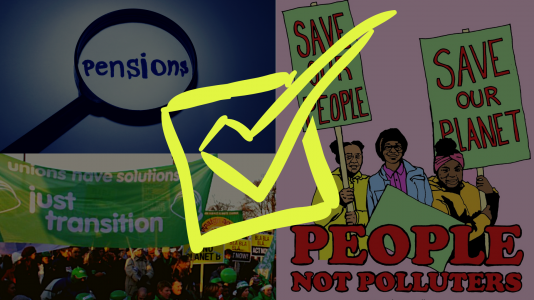
Advocates of just and effective worker-friendly climate protection will need to fight to hold the Biden administration accountable to his stated climate objectives, including: Ambitious four-year targets: The Biden plan requires “milestone targets” for 2025 but does not state what they should be. At the least they should reduce GHG emissions at a rate equal to that required to reach the 2050 goal of net-zero emissions. An effective enforcement mechanism: The Biden plan promises a legally-binding “enforcement mechanism” that will eliminate GHG emissions in the power sector by 2035 and bring all GHG emissions to net zero by 2050. Such an enforcement mechanism must set limits for all GHG emitters. And it must prosecute all emitters who exceed the limits – after all, unless violators are prosecuted, what is the meaning of “legally binding”? Biden’s commitment in this plan is to direct his EPA and Justice Department to “pursue corporations” that “continue to pollute” to the fullest extent permitted by law and to seek additional legislation as needed “to hold corporate executives personally accountable” – including “jail time where merited.” The plan says Biden will commit that every infrastructure investment that receives federal funding should reduce climate pollution as much as possible. So another enforcement mechanism which has therefore been promised is to refuse federal funding to any program unless proponents can prove that it is reducing climate pollution as much as possible. Comprehensive executive action: The plan promises that immediately upon taking office President Biden will issue extensive executive orders on climate. He should be presented with plans for all constitutionally permissible executive orders for climate protection.[1] Effective legislation: The plan demands Congressional legislation within a year and includes many elements that should be in such legislation. However, it is easy to pass legislation that purports to realize specified objectives but in practice won’t actually do so. There are likely to be a lot of fights over inclusion of the elements that are necessary and a lot of proposals that are ineffective, cost-ineffective, or dangerous. It will take fights to ensure that legislation will actually reduce GHG emissions at the necessary rate while maximizing the accomplishment of other GND goals. Effective institutional vehicles: Recent decades have seen a dismantling of government capacity to realize socially desired goals. The Biden plan says little about the building of public institutions to realize its objectives. For any plans to be effectively implemented they will require governmental structures to realize them. Make polluters pay: The Biden plan lays out two different though potentially complementary strategies for meeting the costs of climate protection. The first is through an “enforcement mechanism” based on the principle that “polluters must bear the full cost of the carbon pollution they are emitting.” Since the full cost of carbon pollution is by any measure colossal – equivalent to the full current and future damage of climate change – this has the potential to put the entire fossil fuel industry into bankruptcy. No such mechanism is spelled out, but it could involve regulation or natural resource damages of the kind provided under the Superfund law. To help pay for climate protection, the plan proposes “reversing the excesses of the Trump tax cuts for corporations, reducing incentives for tax havens, evasion, and outsourcing, ensuring corporations pay their fair share, closing other loopholes in our tax code that reward wealth not work, and ending subsidies for fossil fuels.” The United States will cut fossil fuel subsidies in his first year and redirect those resources to investment in clean energy infrastructure. Whatever the means, the Biden plan proposes to put the cost of climate protection on corporations and the fossil fuel industry, not on ordinary people. While that is extremely positive for popular support and popular economic needs, it will no doubt provoke strong resistance from those who will carry the cost. Environmental justice: The Biden climate plan includes “environmental justice” in its name and includes significant if somewhat vague measures to realize it. Many of these measures are likely to provoke significant struggle, since they will allocate environmental and economic costs to different groups. The Biden plan promises to take action against “fossil fuel companies and other polluters who put profit over people and knowingly harm our environment and poison our communities’ air, land, and water, or conceal information regarding potential environmental and health risks.” A Biden administration will “make sure the development of solutions is an inclusive, community-driven process.” It will see that “communities harmed by climate change and pollution are the first to benefit from the Clean Economy Revolution” and that “these communities receive preference in competitive grant programs in the Clean Economy Revolution.” While these promises are quite vague, preference in grants programs provides a specific commitment to which a Biden administration can be held accountable. No worker left behind: The Biden plan pledges that “We’re not going to leave any workers or communities behind.” It promises coal miners and their families will receive promised pensions and health benefits and that companies will pay more into the black lung benefits program. It will establish a Task Force on Coal and Power Plant Communities to help these communities “access federal investments and leverage private sector investments to help create high-paying union jobs” and “keep public employees like firefighters and teachers on the payroll, and keep local hospitals open.” More broadly, clean energy jobs must offer “good wages, benefits, and worker protections.” President Biden will “defend workers’ rights to form unions and collectively bargain in these emerging and growing industries.” While these commitments are rather vague, they offer points on which demands made on a Biden administration will be legitimated by Biden’s own plan. What to Fight Against |